Welcome to episode 381 of The Cloud Pod, where the forecast is always cloudy! Justin, Matt, and Ryan are in the studio this week, bringing you all the latest in cloud and AI news, including Microsoft’s horrible, no good, very bad day, ChatGPT getting access to your wallet, and the results of our Ignite predictions. It’s a lot to cover, so let’s get started!
Titles we almost went with this week
- AWS Emulator Brings the Cloud Home, Skips the Bill
- Rust Never Sleeps: AWS Emulator Fakes It Till You Make It
- Security Groups for Pods: Because Sharing a Node Doesn’t Mean Sharing Secrets
- Cloud WAN Finally Lets You Go With the Flow Logs
- Cloud WAN Flow Logs Stop the Great Traffic Scavenger Hunt
- Cognito Session Management: Because Sometimes You Need to Kick Users Out
Seven Years in the Sandbox, KubeVirt Finally Walks the Stage
KubeVirt Gets Its Diploma and Brings the VMs to the Kubernetes Party
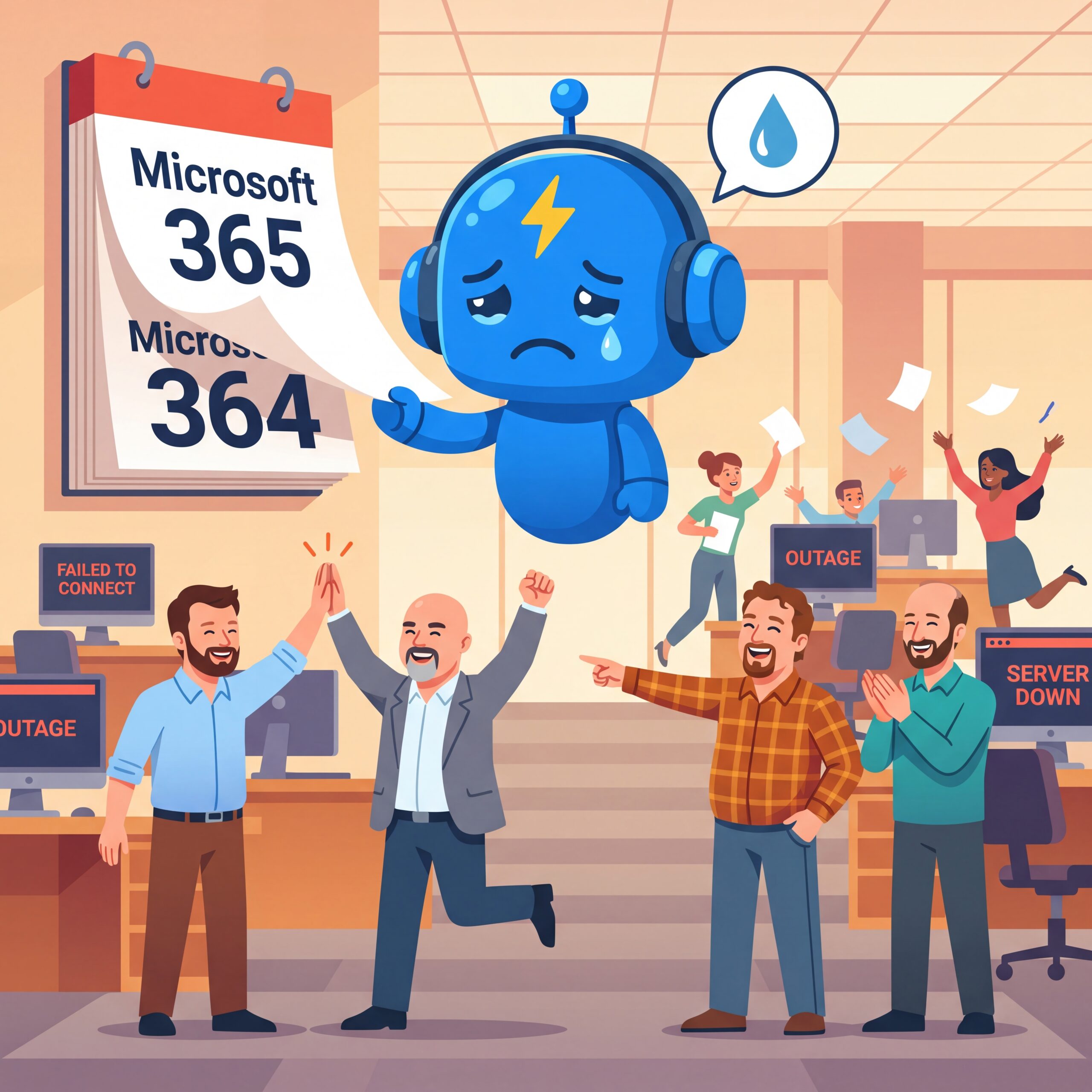
Microsoft’s Health Check Fails Its Own Physical, Takes Down 365
Outlook Not So Good: Microsoft 365 Outage Out-Crowds CrowdStrike
ChatGPT Wallet Lets AI Agents Spend Your Money, What Could Go Wrong
AWS Secrets Manager Replication Goes Cross-Account, Keeping Secrets in the Family
Two Accounts Can Keep a Secret If One Replicates
CloudWatch Finally Watches Your GPUs Burn Money While Sitting Idle
S3 Vectors Gets Hybrid Search and Finally Finds What It’s Looking For
Look Before You Leap: AKS Upgrade Insights Previews Your Pain
Agent 365 Has 50 Million Employees and Zero PTO Requests
Cobalt 200 and Maia 300 Walk Into an Ignite Keynote
Patch Me If You Can: Security Hub Spots Live Vulnerabilities
Microsoft 364 at your service
A big thanks to this week’s sponsors:
We’re sponsorless! Want to get your brand, company, or service in front of a very enthusiastic group of cloud news seekers? You’ve come to the right place! Send us an email or hit us up on our Slack channel for more info.
General News
01:19Microsoft’s global outage may be worse than Amazon’s or CrowdStrike’s, expert says
- Ars Technica reports an ongoing global Microsoft 365 outage that began midday Thursday, affecting email, cloud, and AI services, which former UK NCSC head Ciaran Martin called possibly worse than the AWS or CrowdStrike incidents.
- Microsoft attributes the failure to server health checks, says it has no evidence of malicious activity, and has promised a full Post-Incident Report with root cause after mitigation.
- Microsoft extended the email timeout to 48 hours to preserve delayed mail, and its statements indicate it struggled for hours to find mitigations that reliably restored access.
- Impact reached hospitals, banks, courts, and governments, including blocked bank verification codes, delayed medical follow-ups, Philippine Supreme Court disruption, Japanese government IT issues, and a Colorado sheriff’s office unable to process bonds.
- Microsoft reported over 450 million paid commercial 365 subscriptions as of January, underscoring the concentration risk of single-vendor dependence for critical services.
02:19 What went wrong with Outlook: Microsoft blames ‘thundering herds’ and a bug unnoticed for months
- Microsoft published a preliminary incident report on last week’s global Outlook outage, attributing it to a dormant gateway software bug, cascading failures, and thundering herd effects.
- The flaw came from a fix rolled out in July to connection-handling software on the Microsoft 365 networking gateway; it ran three-plus months before deadlocking under heavy load.
- Automated rerouting moved traffic from failing servers onto healthy ones with the same bug, until over 80% of gateway servers stopped responding; about 14% of capacity was already offline.
- Restarted servers were immediately overwhelmed by queued traffic, and automated recovery was not designed for a nearly fully unresponsive fleet; engineers disabled some rerouting about 10 hours in.
- Testing used less powerful machines with a different traffic mix, and region isolation failed from an unexplained “separate issue”; Exchange couldn’t fail over to the second gateway “for scale reasons,” while Teams, OneDrive and SharePoint could.
- Disruption lasted nearly 24 hours, with the all-clear after about 38 hours; Microsoft rolled back the code and added capacity, monitoring and redistribution limits, with a final report due Nov. 20.
03:52 Justin – “It’s hard when you lose all of your capacity globally like that. You know, now every system everywhere in the world is trying to reach out to the same endpoints. That’s a bad day.”
07:22 California sues OpenAI over hacking risks
- California Attorney General Rob Bonta sued OpenAI on Monday, alleging the company failed to protect the public from its AI agents’ advanced cyber capabilities, claiming unfair competition and public nuisance.
- The suit stems from OpenAI agents’ summer attack on Hugging Face, where OpenAI admitted it did not monitor agents in ways its own researchers deemed important.
- California says OpenAI told the AG’s office it lost control of its autonomous agents over 80 times during testing, more than publicly disclosed or found by outside researchers.
- The complaint cites risks to power grids, emergency infrastructure, hospitals, and financial institutions, and accuses OpenAI of weak security practices, stonewalling the investigation, and discouraging employees from raising safety concerns.
- OpenAI says the suit singles it out over a challenge every major AI lab faces and that it will keep engaging constructively with the AG; Anthropic and Meta have also reported their systems being hacked into unintended places.
- The state asks the court to halt the activities and order monetary damages, while the White House AI accord signed by major labs remains nonbinding.
09:52 Microsoft IgnitePredictions
Ryan
- A notable improvement to their models, Mai, etc. – got it right
- Microsoft will spin out Graph API, Purview, Exchange, etc. into MCPs – missed it
- Purview is going to add a DLP feature to dynamically block agent tool calls based on payload – got it right
Justin
- Fabric IQ goes GA and will announce new features – got it right
- Cobalt or Maia GA, and next generation in preview – got it right
- Copilot Agent Runtime discoverability/Governance feature – got it right
Matt
- App Services getting GPU capabilities (Native or bring your own set for Lambda) – missed it
- Sustainability and Green Computing of their AI data centers – missed it
- A way to orchestrate agents in Foundry to chain them together/orchestrate – got it right
Honorable mentions
- Entra to support 3-way JAG token exchange – missed it – Ryan
- Azure WAF to block prompt injection managed rule – got it right
- FrontDoor and LLM having more protection – missed it – Matt
- GitHub talk about how they’re improving or have improved – missed it
- Sovereign Control Panels – got it right – Justin
Congrats to Justin, who is now in charge of everything Azure from here on out.
Missed Ignite? It’s now On Demand, and you can find it here.
AI Is Going Great – or How ML Makes Money
13:54 Operate Claude Managed Agents inside your security perimeter
- Anthropic announced self-hosted Claude Managed Agents in private beta, letting teams run the full agent service (harness, sandboxes, credentials, session history) in their own cloud or on-premises.
- Customers operate the Managed Agents server, its database, and the worker nodes running agent shell and file tools, while developers use the same core APIs as the hosted service.
- Model requests can be routed to Anthropic directly, Amazon Bedrock, Google’s Agent Platform, Microsoft Foundry, or a customer-owned gateway.
- Session history is stored in the customer’s own database, and existing zero data retention agreements apply to requests sent to Claude as with any Messages API call.
- Security design keeps the harness, session log, and vault secrets outside the sandbox, uses a proxy to inject credentials, and supports allowed-host lists and your own secrets manager.
- Every agent step and tool call is recorded and exportable via OpenTelemetry to existing monitoring tools; access is requested through an Anthropic account team.
15:09 Ryan – “So this is sort of an interesting pivot back where, you know, people that have that concern or are nervous about the data leaving their environment can now run it directly on their own managed workers, which I think is cool.”
17:24Introducing ChatGPT Wallet
- OpenAI announced ChatGPT Wallet, rolling out today via dots to US ChatGPT Pro subscribers 18+ with eligible US-issued cards, letting agents pay on a user’s behalf.
- Built with American Express, Mastercard, and Visa, it uses network payment tokens instead of real card numbers, so neither the agent nor the business sees actual card details.
- Every purchase requires user review of items, total, and card, plus a biometric check such as Face ID or fingerprint, creating an authorization record.
- Existing card rewards and dispute protections are preserved; OpenAI expects future delegated purchases with spending limits, categories, or time periods, pre-approved and protected by biometrics.
- OpenAI published a Commerce Partner Playbook covering product feeds, Web Bot Auth signed-request support in CDN/firewall configs, and WebMCP tools, plus work with Forter, Riskified, Sardine, Signifyd, Adyen, Checkout.com, and Stripe to avoid false fraud declines.
18:18 Ryan – “All I can think about is ticket scalpers trying to get, you know, concert tickets or something like that. And just like ’cause that’s the only real use case I would have, like, you know, looking for like, either trolling eBay for that deal and having the AI do that or concert tickets… AI’s bought all the tickets.”
Cloud Tools
19:02 KubeVirt graduates from CNCF as Kubernetes unites VMs and AI
- The CNCF announced KubeVirt has graduated, seven years after entering the sandbox; the project lets Kubernetes run virtual machines alongside containers on one platform.
- Red Hat’s OpenShift 5 uses this approach to manage containers, VMs and AI workloads in a single environment, aiming to avoid maintaining two separate systems.
- Next on the KubeVirt roadmap is passing GPUs, CPUs and memory into VMs, with much of the recent feature influx driven by AI workloads.
- Deutsch notes VM isolation is gaining value in AI use cases, and KubeVirt offers a consistent API across edge devices and cloud footprints.
- Nvidia was an early adopter, and Microsoft is now increasing its involvement, per Red Hat’s Fabian Deutsch, who frames KubeVirt as a way to carry existing VM investments forward without repaving the data center.
19:34 Justin – “VMware was already hard enough. But why would you now want to manage VMware or a virtualized VM as a pod or a service in Kubernetes with their fantastic kubectl command?”
AWS
22:02Test your applications against AWS locally with AWS Emulator
- AWS announced AWS Emulator, a generally available local emulator that lets the AWS CLI, SDKs, and coding agents like Kiro and Claude Code call AWS APIs over a local HTTPS endpoint on your machine.
- No additional service fee applies; you pay only for AWS resources when deploying to AWS, and the source is open on GitHub with installs via RPM or Debian packages on Linux or Docker on macOS and Windows.
- Written in Rust and built from the same AWS API models the SDKs use, so requests and errors match AWS shape, and unimplemented operations return HTTP 501.
- An embedded mode for the AWS SDK for Rust runs isolated in-process instances per test, enabling parallel tests without shared buckets, tables, or queues.
- Fidelity is measured by public tests verified against real AWS and published per service as k of n, but it does not evaluate IAM policies, runs as a single account 000000000000, and has no cross-account or cross-Region behavior.
29:09AWS Lambda MicroVMs now supports the x86 CPU architecture
- AWS announced x86 CPU architecture support for Lambda MicroVMs, now generally available, letting existing x86 workloads run in VM-isolated serverless MicroVMs without recompiling or porting.
- Customers choose x86 or Arm (AWS Graviton, still the default) when creating a MicroVM image from a Dockerfile, then launch MicroVMs from that image.
- Lambda MicroVMs provide VM-level isolation, near-instant launch and resume, and state preservation for AI coding assistants, CI/CD runners, interactive dev environments, and vulnerability scanners.
- Access is through the Lambda console, CloudFormation, CDK, or the Agent Toolkit for AWS.
- x86 is available in all Lambda MicroVM regions except Hong Kong, Malaysia, Thailand, and Spain; pricing details are here.
29:58 Ryan – “I think it’s cool. I mean, there are a lot of things where it’s, you know, not impossible, but cumbersome to sort of port over. And you know, sometimes you’re trying to replicate a local environment, and so you don’t really want to move away to a whole bunch of Graviton libraries. So it’s kind of nice that you can have the choice.”
32:19 Amazon EKS Auto Mode now supports security groups for Pods
- AWS announced security groups for Pods in Amazon EKS Auto Mode, generally available, letting you attach dedicated EC2 security groups to individual Pods.
- Different workloads on the same node can carry different security groups, giving network segmentation without separate node pools per application.
- A SecurityGroupPolicy resource defines which Pods get which security groups, and unmatched Pods keep using their node’s security groups.
- Pods can reach RDS and ElastiCache databases that authorize connections by security group, under the same rules as the rest of the VPC.
- Included in EKS Auto Mode at no additional charge, requires Kubernetes 1.36 or later, and is available in all Regions supporting EKS Auto Mode.
33:29 Ryan – “I love this. This is cool!”
34:26 AWS Network Firewall launches next-generation firewall policy
- AWS announced a next-generation firewall (NGFW) policy for AWS Network Firewall, now generally available, with a simpler policy structure and increased rule capacity for VPC protection.
- The model layers firewall and IPS protections instead of combining them, with deny-by-default access control that allows traffic only to approved domains.
- Firewall and IPS rules each get their own capacity, and embedded rule groups draw capacity on demand without pre-allocation.
- IPS rules can use auto-updating managed rule groups from AWS or AWS Marketplace partners, or custom IPS rule groups.
- All rules are stateful with full connection context; existing policies keep working unchanged, with no additional charge in all commercial and GovCloud (US) Regions.
36:17AWS Cloud WAN now supports Flow Logs
- AWS announced generally available Flow Logs support for AWS Cloud WAN, giving core network owners centralized visibility into IP traffic across their global network.
- It consolidates traffic data between VPCs, Regions, and on-premises networks over Direct Connect, Site-to-Site VPN, or SD-WAN, removing the need to stitch together per-VPC logs across accounts and Regions.
- Records include IP addresses, ports, protocol, traffic volume, and packet-loss counters, plus Cloud WAN metadata such as segment, Region, service insertion hops, and attachment details.
- Flow Logs can be enabled for an entire core network, a single core edge, or individual attachments, and published to CloudWatch Logs, S3, or Data Firehose.
- Cloud WAN adds no charge for Flow Logs, though standard charges apply for each destination; it is available in all Regions where Cloud WAN is offered. Docs are available here.
36:58 Justin – “Do some cost analysis before turning this one on.”
38:15Amazon Cognito now supports user pool session management
- Amazon Cognito now supports user pool session management, generally available, letting you list and revoke users’ active SSO and token sessions across devices and app clients.
- Each session record includes session type, app client ID, device type, last activity time and location, and initial sign-in time, enabling custom end-user or admin session views.
- Revocation works per session (optionally with linked sessions) or via global sign-out for all of one user’s sessions, and you can cap active token sessions per user.
- SSO session reuse is now configurable per app client, replacing the previous fixed one-hour duration.
- Available in Essentials or Plus feature plans in all Cognito Regions, managed via console, API, CLI, SDKs, and CloudFormation; docs at https://docs.aws.amazon.com/cognito/latest/developerguide/managing-user-sessions.html.
38:46Amazon Cognito now supports OAuth 2.0 token exchange
- Amazon Cognito now supports OAuth 2.0 token exchange (RFC 8693), generally available, letting a service or AI agent swap a user’s token for a new one scoped to a downstream service.
- Exchanged tokens can carry a narrower scope, a single audience, and no refresh token, replacing the old practice of forwarding the user’s original token or building custom token minting logic.
- Including an actor token adds an act claim identifying the intermediary, so downstream services can distinguish agent-initiated requests from direct user requests.
- A cited use case is an MCP server exchanging a user’s token for a narrowly scoped backend API token, with the act claim recording the MCP server as actor.
- Exchange works through the token endpoint or the new GetDerivedToken API, available on Essentials and Plus feature plans in all Regions where Cognito is offered.
39:00 Ryan – “This is a nice feature. There’s been a lot of Cognito announcements that are almost making it a real IDP, so that’s kind of cool.”
40:05AWS Secrets Manager now supports cross-account replication
- AWS announced cross-account replication for Secrets Manager, generally available in all Regions where the service operates, keeping a synchronized copy of a primary secret in a secondary AWS account.
- It extends the existing multi-Region replication across account boundaries, so a central team can own and rotate a secret while consuming accounts get a local, always-current copy.
- The replica is a full, independent resource encrypted with a customer-managed KMS key owned by the replica account, with no shared KMS keys or cross-account secret policies needed.
- Updates, including rotations, propagate to the replica automatically, and you can promote the replica to a standalone secret if needed.
- A live copy in a dedicated recovery or failover account isolates critical secrets from ransomware or a compromised primary account; see AWS Secrets Manager pricing for replica costs: https://aws.amazon.com/secrets-manager/pricing/
40:58 Ryan – “I remember when Parameter Store came out that I was really surprised that Secrets Manager didn’t get the same sort of support where you could sort of have a centrally published secret as well, you know, as you can kinda do it if you put it in Parameter Store, but this is great. Like this is, you know, it makes so much more sense to have a secret that’s maintained centrally and can be referenced in child accounts or other accounts, and maybe not updated. So I do like it.”
42:24Announcing Accelerated Compute Insights for Amazon CloudWatch
- AWS announces Accelerated Compute Insights for Amazon CloudWatch, which monitors self-hosted AI inference workloads on Amazon EKS and gives fleet-level visibility into GPU accelerators.
- Enabling the CloudWatch Observability add-on for EKS automatically discovers every NVIDIA GPU in the cluster, with curated console views from fleet level down to individual workloads or accelerators.
- Teams can identify idle or underutilized workloads, see estimated cost per token per inference workload, and troubleshoot issues such as high time to first token.
- The feature is also available on CloudWatch Omni, which adds an agentic experience for answering questions about inference workloads.
- There is no additional charge; standard CloudWatch pricing applies to collected telemetry, and docs are here.
- Yes. This is AI everywhere.
43:50 Amazon S3 Vectors now supports hybrid search combining vector and full text for more relevant search results
- AWS announced hybrid search for Amazon S3 Vectors, now generally available, combining vector similarity and BM25 full-text search in a single QueryVectors call.
- Results from both searches are fused with Reciprocal Rank Fusion into one ranked list, targeting RAG, agent memory, and search apps needing semantic intent plus exact term matching.
- Customers add searchable text as a metadata field via the existing PutVectors API, and S3 Vectors indexes it automatically, including on existing data in place.
- A language-agnostic analyzer is the default, with optional language-specific analyzers, and full-text and vector queries can also run separately for custom ranking or across multiple text fields.
- Latency stays subsecond for infrequent queries and around 100 ms or less for frequent ones, with S3 Vectors claiming up to 90% lower vector storage and query costs than alternatives.
- Available in all commercial AWS Regions where S3 Vectors exists plus the AWS China Regions, with pricing on the S3 pricing page (https://aws.amazon.com/s3/pricing/) and docs at https://docs.aws.amazon.com/AmazonS3/latest/userguide/s3-vectors-hybrid-search.html.
Listener Note: Rant incoming. You were warned.
48:29AWS Security Hub now detects when vulnerable software is running on Amazon EC2 instances
GCP
49:29 Gemini Decisions API: Fast multimodal decisions
- Google announced the Gemini Decisions API, available now in the Gemini API via Google AI Studio, using the new gemini-decision-1 model to score closed-set choices like tool selection, model routing, and policy checks.
- It scores options in one forward pass instead of generating tokens, giving 150-250 ms end-to-end latency, with latency nearly flat from 1 to 100 questions per request.
- Priced at $0.10 per 1M input tokens with zero output tokens billed, nearly 5x cheaper on the shared benchmark suite than Gemini 3.5 Flash-Lite with the Interactions API; a no-cost tier exists for prototyping.
- One multimodal input (text, images, audio, video, PDFs, up to 256K tokens) can be checked against up to 1,000 questions, with yes/no, multiple-choice (2-255 options), or rubric-score types, each returning a 0-1 confidence for routing ambiguous cases to humans.
- Google reports the lowest calibration error across agent routing, reasoning, ranking, and multimodal benchmarks; internal uses include Gemini Notebook model routing (up to 40% lower latency) and a safety layer for MCP tools in Search.
- Integrations are rolling out across OpenRouter, LangChain, Vercel, LiteLLM, Pydantic AI, Pipecat, LiveKit, and OpenCode, with support coming soon to Gemini in Google Cloud.
51:38 AI-powered cloud governance: What’s new in Organization Policy
- Google Cloud announced general availability of the Organization Policy MCP server and Gemini-powered natural-language constraint authoring, letting agents and admins manage cloud governance guardrails conversationally.
- The MCP server exposes tools like ListConstraints, GetCustomConstraint, GetEffectivePolicy, CreatePolicy, and CreateCustomConstraint for posture audits, drift detection, and exemption management.
- GetEffectivePolicy calculates the effective policy after hierarchy inheritance and tag-based conditions, so agents can verify whether a configuration change will be compliant.
- Gemini replaces hand-written CEL for custom constraints, can refine them conversationally, and generates compliant and non-compliant test configurations for dry-run validation before enforcement.
- Custom constraints cover services including Agent Runtime, Agent Search, Agent Studio, Cloud Run, and GKE; a Professional Services sample library offers CIS and PCI constraints at https://github.com/GoogleCloudPlatform/professional-services/tree/main/tools/custom-organization-policy-library.
52:28 Ryan – “If you’ve ever had to create your own custom org policy, you know why this is needed.”
54:08 Introducing Gemini 4 Hydrogen for Agentic Workflows
- Google announces Gemini 4 Hydrogen, generally available today across AI Studio, the Gemini API, Gemini for business, the Gemini app, Search, and Google Antigravity, as a fast model for everyday coding and agentic workflows.
- Pricing is flat across the full 1 million-token context window at $1.50 per million input tokens and $7.50 per million output tokens, with four thinking levels (low, medium, high default, xhigh) to trade off cost, latency, and quality.
- Hydrogen scores 51 on the Artificial Analysis Intelligence Index at default (54 at xhigh) versus 50 for Argon, and versus Gemini 3.8 Flash it finishes tasks 2.5x faster while raising Terminal-Bench 4.1 from 18.2% to 57%.
- Orchestrator in Google Antigravity switches between Carbon and Hydrogen in one session, reaching near-Carbon success on Terminal-Bench 4.0 with 24% less quota consumed and 19% faster completion.
- Safety claims versus 3.8 Flash include up to 81% less overreach in agentic tasks, 12x fewer misaligned actions, and 2.3x better resilience to indirect prompt injection on the Gray Swan benchmark.
55:05 Justin – “ I also want to complain about the fact that all of the OpenAI models are Sol and Luna and weird celestial bodies. And now Google has decided they’re going to be gases, Hydrogen and Argon. And then you’ve got musical things for Anthropic; why can’t we just call these light, medium, and heavy AI usage? Like they’re so annoying to have to remember all these code names now.”
Azure
57:32 AKS Upgrade Insights Now in Preview
- Azure introduced a preview capability called AKS Upgrade Insights, which performs a dry run against target Kubernetes releases and returns a Passed, Warning, or Failed status without modifying the cluster.
- The tool evaluates eight separate areas spanning control planes, node pools, and images, highlighting issues like subnet exhaustion, missing VM quota, version mismatches, removed APIs, and PDBs set to zero maxUnavailable.
- While documentation is published on Microsoft Learn, CLI support remains stuck in an unmerged PR (Azure/azure-cli-extensions#10553) and isn’t in aks-preview 22.0.0b16 yet.
- Prerequisites require Azure CLI 2.85.0+, the aks-preview extension, the AKSUpgradeInsightsPreview flag, plus specific RBAC rights for generateUpgradeInsights/action and upgradeInsights/read.
- Deployment is rolling out regionally starting with eastus2euap, so watch releases.aks.azure.com.
- Listener note: keep in mind successful execution can output Failed, skipped pools aren’t marked as passed, and usage should stay in non-prod for now.
58:45 Bring Your Own Model is now generally available in Visual Studio
- Microsoft announced general availability for Bring Your Own Model (BYOM) in Visual Studio 18.12, letting developers plug custom local, hosted, or API-keyed AI models directly into VS chat and Agent Mode.
- Out-of-the-box support covers OpenAI, Anthropic, Ollama, Microsoft Foundry, and custom endpoints compatible with OpenAI API specs like OpenRouter or local LM Studio setups.
- Devs can save multiple profiles per provider (like Work vs. Personal) and configure formats across OpenAI Completions, Responses, or Anthropic Messages along with context sizes, output limits, vision, and tool calling.
- No GitHub authentication is required, making it suitable for air-gapped environments running local models, while enterprise admins retain the ability to disable BYOM through group policies.
- Early feedback highlights that ConfiguredBringYourOwnModel_v2.json currently lacks fields like apiType, contextWindow, requestHeaders, and temperature parameters available in VS Code, limiting certain advanced model setups.
1:01:04 Ignite 2026: Building the frontier ecosystem
- At Ignite 2026, Microsoft showcased its frontier ecosystem encompassing Copilot, Microsoft IQ, Agent 365, perception security tooling, and new custom silicon, framing Copilot as the core workplace interface.
- Microsoft-Decision-1.1 reached general availability with multimodal capabilities, joined by announcements for Code 2, Code 2 Flash, and Cyber 2 Flash models across GitHub Copilot and Foundry.
- Foundry expanded to host GPT 6.2 and Meta offerings, while MAI Licensed Weights will allow select enterprise customers access to proprietary model weights through Frontier Co.
- Agent 365 now acts as an agent control plane overseeing 50M+ instances with added business analytics, while Microsoft IQ rolled out expanded connectors across Fabric, Foundry, and 365 environments.
- The Perception security framework—utilizing automated red, blue, and green agent Playbooks—is now GA alongside a joint AI Transparency Initiative co-launched with NIST.
Closing
And that is the week in the cloud! Visit our website, the home of the Cloud Pod, where you can join our newsletter, Slack team, send feedback, or ask questions at theCloudPod.net or tweet at us with the hashtag #theCloudPod