[00:00:00] Speaker A: Foreign.
Welcome to the cloud pod where the forecast is always cloudy. We talk weekly about all things aws, gcp, and Azure. We are your hosts, Justin, Jonathan, Ryan, and Matthew.
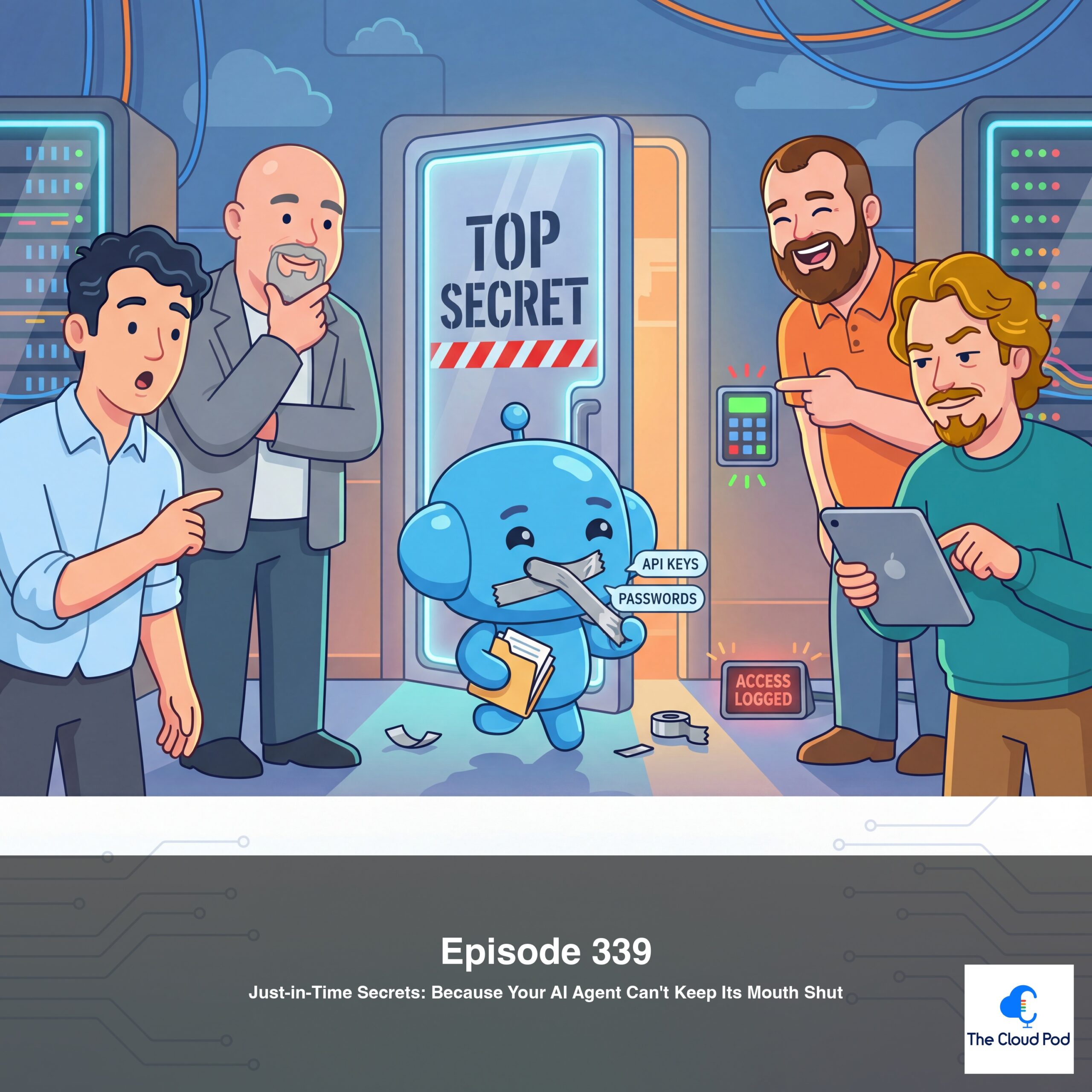
Episode 339 recorded for January 20, 2026. Just in time secrets, because your AI agent can't keep its mouth shut. Good evening, Matt. How you doing? Good.
[00:00:29] Speaker B: How are you?
[00:00:30] Speaker A: Good. We were doing so well. We had three, you know, over three hosts for multiple weeks, and then we hit today.
[00:00:36] Speaker B: Wait, do we have all four hosts for the first two weeks? Well, we.
[00:00:40] Speaker A: We have. Well, Jonathan had to drop out when we did the back to back for the second episode. Technically, he was there for the first episode we recorded that day and it wasn't there for the second. And then he was back for last week. So.
[00:00:51] Speaker B: So I'm three for three. I'm still a little bit upset about the. The unreliable data that we use. I'm going to contest it at one point.
[00:00:58] Speaker A: And he says, Heather calls you out in the show notes. I think you should blame it on Heather because I had to use Heather's, you know, introduction in the paragraph. And so if she didn't mention who the hosts were in that episode, I don't, I. You didn't get counted. And so for all I know, she had a bias against episodes where it was just you and me. And so she just didn't put Justin and Matt join us this week in this thing. And so I wasn't able to scrape for that and that when I did my. My search. So that's why this year we have, you know, in the show notes, we have specifically who is here. So we're, we're tracking this for better metrics. So you. If you were right, I think it'll prove it out by the end of the year.
[00:01:31] Speaker B: So I'm going to go in. I'll have Claude workspace, what is it? Coworker, whatever, go through each episode, try to see if it'll listen to it the first five minutes and see if I say hello. If I do, then reset it. So that'll be my side project over the next couple weeks whenever I have time in my life.
[00:01:48] Speaker A: I mean, technically you could probably, maybe if you wanted to go through and like re transcript all of last year's episodes, you could then probably just use transcripts because the transcript service we have recognizes speakers. But, you know, just there's options, you know, things you can do.
[00:02:08] Speaker B: I don't think I have enough time in my life for that. But it does sound.
[00:02:10] Speaker A: Yeah, probably not.
[00:02:11] Speaker B: Yeah, there's not a value in it. It's more like maybe just to make fun of Ryan a little bit. But I was a little bit offended that I did not show up though I did have a kid, so maybe last year's a little bit of a blur and half the weeks are a blur.
[00:02:23] Speaker A: So I mean, you did, you were out of a couple weeks when you had the baby. So I mean it all could play out. I mean, I, I, I agree with you. I feel you were here significantly more than Ryan was and definitely more than Jonathan was. So I, I feel you. I, I was surprised at the metrics too. I was surprised. Now it's either because Ryan's just not very memorable to me when he's on the show. I don't know. But, and I can say because he's my friend, so.
And he won't listen to this episode anyway, so that's fine.
[00:02:48] Speaker B: Yeah. So we're fine.
[00:02:50] Speaker A: He'll never know. He'll never know anyways.
All right, well, let's get into some news. A couple acquisitions to start out this week, Cloudflare is acquiring the Astro technology company, bringing the popular open source web framework in house while maintaining its MIT license and multi cloud deployment capabilities.
Major platforms like webflow, Cloud, wix, Vibe, and Stainless Steel already use Astro and Cloudflare infrastructure to power customer websites. Azure 6 introduces a redesigned development server built on the Vite Environments API that runs code locally using the same runtime as production deployments. Using the cloudflare Vite plugin, developers can test against worker runtime with access to durable objects, D1KV and other Cloudflare services during your local development. The framework focuses on content driven websites through its island architecture, which renders most pages as static HTML, while also selectively providing client side interactivity using any AI UI framework you like. The approach addresses the complexity that made building performances difficult before 2021, providing a simpler foundation for both human developers and AI coding agents. I mean, this is kind of interesting as well because there was some recent news about Tailwind css laying off 80% of their staff. They blamed AI for that because basically people don't need to come to their website to get the enterprise versions or to get better support or documentation because AI is so good at what it does with Tailwind's code. So I imagine Astro maybe was a vendor, maybe a bit of pressure as well perhaps. And so this is a good exit for them to Cloudflare, which is a big supporter and fan of theirs in general.
[00:04:17] Speaker B: Yeah, I would assume that they heavily use it internally, so you know hopefully it's something that they can leverage, continue to grow and, you know, they'll have to redevelop their platform because I feel like they've had a lot of oopsie daisies in the last year or so with issues, so they don't need a front end issue occurring anywhere.
[00:04:35] Speaker A: Yeah, they definitely taken a bit of a reputational hit in the last quarter with a bunch of their outages and issues that they were having. Yeah, and that's why I think their CTO had a blog post right around Christmas time where he was, you know, basically saying, we're going to get back to what we're known for, which is stability and reliability.
So good, good to see it.
Cloudflare is also acquiring Human Native, a UK based AI data marketplace that transforms multimedia content into structured searchable data for AI training.
This acquisition accelerates Cloudflare's AI Index initiative, which uses a pub sub model to let websites push structured content updates to AI developers in real time. Instead of relying on traditional web crawling, Human Data's platform focuses on licensed, high quality training data rather than scraped content. The one UK video AI company reportedly discarding their existing train data after achieving better results with Human Native's curated data set. Activision builds on Cloudflare's existing AI crawl control and pay per crawl products, giving content owners more control over how AI systems access their content.
Yeah, so we block you from getting to people's AI content and now we offer a way for you to buy better content. That's a well well played move by Cloudflare. It's a one, two punch.
[00:05:40] Speaker B: Yeah, I mean it's smart. They can, you know, they block everything and if you want to, hey, give me some money on this side. So you know, they get it on both sides. They get it from the vendors saying, no, you can't access it. On the flip side, they have a new, whole new customer base.
It also, you know, will help the customers, you know, go back to what you just said, more stable platform, you know, because they can, they have it only get crawled once, you know, by Cloudflare, block everything else, which, you know, you were saying in the pre show you were mad that a website you were trying to get to blocked all the AI bots from accessing it, you know, and this hopefully will help their customers become more stable and they have it. So you know, on the flip side, from a stability, you know, it's a smart play on both sides for them. I don't know what the acquisition cost was and what the revenue stream is going to be, but it seems like a pretty good play to handle, you know, keeping their customers up and stable.
[00:06:33] Speaker A: Agree. Well, let's move on to AI is how machine learning makes money. This week, Anthropic is launching a lab as a dedicated team focused on incubating experimental AI products at the frontier of cloud's capabilities. Led by the Instagram co founder Mike Krieger and Ben Mann, this organization shifts separate rapid experimentation from product scaling, with Emil Amiya Vora taking over as head of products focused on enterprise grade cloud experiences. The Labs approach has already produced several products that have moved from research to production, including Cloud code, which reached $1 billion in revenue within six months of launch, and the MCP protocol, which now has over 100 million monthly downloads and has become an industry standard for connecting AI systems to tools and data. Recent lab efforts include Skills, Claude and Chrome and Cowork, which launches a research preview to bring Cloud's agentic capabilities to desktop environments. This demonstrates the team's focus on exploring new interaction models and deployment patterns for large language models beyond traditional chat interfaces.
The organizational structure created two parallel Tracks Labs for frontier experimentation with unpolished versions and early user testing, and the core product organization partnering with CTO Rahul Patil to scale proven experiences for millions of daily users and enterprise customers. Separation aims to balance innovation velocity with reliability requirements. Apparently they're actively hiring for those lab positions, especially targeting builders with experience creating consumer products and working with emerging technologies. The team structure reflects the company's view that rapid AI advancement requires different organizational approaches than traditional product development life cycles.
[00:07:58] Speaker B: I mean, the fact that you can get a lab to a GA customer product and, you know, cloud code and MCP where it's now used is a really hard thing because a lot of these times, you know, as a product company, getting something from a lab PRC into a stable platform takes a lot of work and they seem to have done a pretty good job at that with all these different technologies. Now granted, you know, we'll see how long a lot of them live. Like the Claude Chrome plugin I think is going to die. Not directly, but, you know, is used in other aspects of the platform, like the cowork thing, Cowork tool they just released. But it has a nice, you know, they're doing a really good job. They continue to kind of build that lab to product feature and have, you know, failures that are called out here, but they can have a lot of those failures that give them the technology in order to build new features and use, you know, new. I want to say skill sets, but that's not the right thing. New tools and new product lines, it's just another, it's a great revenue stream. You know, let developers, let builders go play with things and they can do amazing things at times.
[00:09:08] Speaker A: Yeah, I mean, I think the Chrome plugin probably is gonna stick around because it does have a value to the cloud code side as well, especially for like testing web applications and doing, you know, web dev tools, that kind of stuff.
Um, but yeah, there's definitely a platform component to Claude like the AI models of the platform. So is the, potentially the Chrome web browser MCP is part of the platform and then how do you build on top of those as products through cowork and through the cloud chat interface, et cetera. So it is interesting how fast they can do it. And I think, you know, but this is like most startups, most startups, you know, are small, nimble teams. You know, then you get into large enterprises that have, you know, dev teams of hundreds of people and all these features and you know, that's why a lot of times startups are more nimble and more capable of, you know, leapfrogging bigger organizations with more bureaucracy. You know, the question will be is does this innovation pace continue over time or does it slow down as, you know, maturity comes into the model, into how they can do business and make revenue and not be burning so much free capital. Well, not free capital, but free debt.
[00:10:11] Speaker B: Yeah, I mean they definitely the advantage of having a lot less tech debt than you know, a 5 or 10 year old company. I guess they are 5, you know, 10, 15 year old company.
[00:10:20] Speaker A: Well, in many ways with the speculation in the AI market, they're basically the only, one of the only companies that can get basically access to zero interest dollars.
You know, other than they have to show a return on that investment as really all the AI companies. So, you know, now we don't have zero interest rate loans out there in the market feeding startups and startup ideas. Uh, it's definitely a different world, so we'll see.
Uh, we talked briefly about Mira Moradi in the production episode this year, uh, and what it's going to have with thanking Machine Labs, which is valued at 12 billion after a 2 billion seed round last July. It was founded by Mira and many of the founders of OpenAI but apparently they just lost two of the three co founders back to OpenAI within a year of the founding of the company. Barrett Zoff, who served as CTO along with co founder Luke Metz and researcher Sam Schoenhelz, returned to OpenAI waiting what reports suggest was not an amicable departure. Apparently there was some dating in the workplace. Never approved, never appropriate, apparently, and there was some fallout that occurred around that. Per the rumor mill, Sarep has now lost four key personnel in under year, including co founder Andrew Tullock, who left for Meta in October. Sumit Jintala, who was promoted to replace Zof as cto, brings over a decade of AI field experience to that role. Rapid co founder departures raised questions about Thinking Machine's internal dynamics and strategic direction, particularly given the company secure backing from major investors, including Andreessen Horowitz, Excel, Nvidia and amd. Sarb has not publicly disclosed what products or services it is developing, despite the substantial funding, which that's my prediction for the year, is that we'll find out what Thinking Machines is actually working on sometime this year. But you know, the AI market is still very competitive. There's still lots of movement and so yeah, if you don't like what's going on, you just quit and you can get a job back at where you came from or another startup that's trying to pay through the nose for AI talent.
[00:12:05] Speaker B: I think you just put this in there just to show that you were right and you're, you know, three weeks into the year just saying, I mean.
[00:12:12] Speaker A: They didn't announce what they're doing. It just, it's turmoil in the space. Right. So.
[00:12:17] Speaker B: No, I know, yeah. It's interesting that they're going back to OpenAI. So it'll be curious, you know, with NDAs and other things in place, like how all that's going to work. They are going to go straight back if it's going to just take time. You know, I'm always curious about that type of stuff with that knowledge gap, you know.
[00:12:35] Speaker A: So, I mean, I, it seems like a ton of founders left OpenAI.
It does feel like they, it kind of impacted their ability to innovate for a little bit there, which I thought maybe was some of the reason why ChatGPT 3.5 to 4 was such kind of a minorly, you know, minor enhancement versus others. But I also think that could be a reflection of the models and their ability to get better from where they're at today. So it's, it's really a question of is that a momentum problem or is it a capability problem? But we'll see if maybe if OpenAI starts moving much faster and starts launching cool products again within six months, you can maybe point back to the talent thing. So we'll Keep an eye on the space, we'll see what happens.
[00:13:12] Speaker B: I would just say six to nine months. Yeah, Give them a little bit of time to get in, make their mark, you know, and make those changes again.
[00:13:18] Speaker A: I mean, I assume that they're more familiar with how OpenAI works already because they came from there.
[00:13:22] Speaker B: Oh, that's true, yeah.
[00:13:23] Speaker A: And so, you know, do. Is it take quite as long?
[00:13:25] Speaker B: Maybe by the end of the year. We'll see.
[00:13:29] Speaker A: We'll see.
[00:13:29] Speaker B: Yep.
[00:13:30] Speaker A: OpenAI is adding 750 megawatts of dedicated low latency inference capacity through a partnership with Cerebras. Cerebras. I don't know how to say that. Cerebras deployment rolling out in phases through 2028. Cerebras uses a unique architecture with a single giant chip that combines compute, memory and bandwidth to eliminate traditional bottlenecks in AI inference. Partnership focuses specifically on accelerating real time AI responses for workloads like complex queries, code generation, image creation and AI agents. Cerebras systems are purpose built for fast token generation during the output phase of inference, which is a critical interactive AI application where users expect immediate responses.
This addresses the request Think respond loop that determines user experience quality. I mean in general, anybody who can get you AI capacity is apparently a must do.
And so that they have something that can help them move faster somewhere with ability to get more wafers and more US GPU capacity is something that every AI startup is looking for because Nvidia can't deliver it all right now.
[00:14:29] Speaker B: So they've, they're, they've built their own hard, their own chip.
[00:14:32] Speaker A: Yes, yes, Yep. That's like a custom, custom silicone sort of, sort of like a Trainium chip or whatever the Google one is called.
[00:14:43] Speaker B: Got it. Yeah, I was reading it. I was a little bit confused because I know I was like they're not just power, you know, but it looks like even there's a bunch of articles about how like it's, they're using a much larger chip too than like traditional chips. So how they're leveraging and kind of putting all that into one place.
I mean it makes sense that there's less things for it to do when, you know, you can all stay a little bit more local. But you know, it's, I think like one of the rejected show tales was, you know, it's amazing how well you're doing when you're buying, you know, somewhat on speculation too.
You're spending, what was it, 10 billion or something on pure speculation.
[00:15:21] Speaker A: Yeah, that's crazy.
It was written A long time ago by many cynics of the chat GPT industry is that this business model was not sustainable and so that eventually ads would come to to OpenAI models or LLMs in general or chat type interfaces. And apparently it's happening. ChatGPT Go is global, launching globally at $8 per month, creating a three tier subscription model with Go plus and Pro. The Go tier provides 10x more messages, file uploads and image creation than the three tier with access to GPT 5.2 instance plus, longer lemony and context windows for improved conversation continuity, pricing strategy positions. Go is an entry level paid option for users who need more capacity than the Free tier. They don't require the advanced reasoning capabilities of GPT 5.2 thinking or GPT 5.2 Pro. As part of this announcement they also said that they are looking into ways to start monetizing with ads. Although they are committing that the Plus Pro Business Enterprise tiers will remain ad free, but they will be interesting in both the Free tier and the ChatGPT Go tier in the US at some point. Zad supported model aims to sustain free and low cost access points while generating revenue from users who don't need premium features. The tier approach reflects a shift towards market segmentation similar to traditional SaaS models with clear differentiation between casual users, professionals and power users.
[00:16:35] Speaker B: Ads are coming to AI. We all knew it was coming. They have to find additional ways to monetize it. What I am curious about though is if how long they'll hold their word on the Pro plus and whatever the other tier is. You know, I will actually stay ad free. Market will be like Amazon where they just slowly keep creeping in ads in different places. You know, it's the movies are ad free. Okay then then there's different tiers. Your Kindle has ads on it now, you know, so kind of curious how long they'll stick with their word of it or they'll just always kind of add things or it'll be like oh we have a plus, you know 2.0 and plus is $20 plus $2 $18 but $18 gives you ads.
I always kind of wonder, I'm really.
[00:17:24] Speaker A: Curious to see what ads look like in chat GPT. I mean like is it going to be, you know, I'm asking it for medical advice or suicide prevention or something. It's going to give me an ad for something completely inappropriate that time. I mean like there's so many questions that are going to come into this type of setup that I just based on some of the Things I've seen go wrong already. I'm sort of nervous for this a little bit. Like I'm worried about the horror stories are gonna come out because there's already horror stories of people who are paying for the real versions. And now all of a sudden you're getting an ad for, you know, if you're an alcoholic or recovering alcoholic and all of a sudden you get an ad for whiskey, is that gonna, you know, potentially cause you issues? Or how and how's that ad interpreted? Is it can become part of the chat response or is it very clearly an ad? I mean, so many questions about how this is actually gonna get put into play.
[00:18:08] Speaker B: I feel like it's gonna be like the Google where just is sponsored there. But I also feel like at this point in Google, the first six responses are all sponsored links.
[00:18:16] Speaker A: Yeah, but at least it's very clear in, you know, Google what's an ad and what's not. So I mean I do, I did ask their website, you know, their chat doing so they say, they say it'll be marked as sponsored. So you know, it's a commercial and it'll be contextual and relevant to your conversation. That's where I get nervous.
And it'll be simple visual units, so it's and it's not supposed to influence your answer. So we'll see. But time will tell what it actually ends up doing.
All right. Moving on to cloud tools, 1Password is integrating with cursor, the AI powered IDE to provide just in time secrets management through cursor hooks that validate and inject credentials at runtime without ever storing them on disk. This eliminates the common secure risk of developers hard coding API keys or committing secrets to source control while working with AI coding assistance. Integration works by running a hook script before Christopher's AI agent executes shell commands, verifying that the required Environment files from 1Password Environments are properly configured and prompting users to authorize access only when needed. Stakers remain in memory for the runtime session only and never touch disk or get history, maintaining zero trust principles while keeping development velocity high. This is a critical gap in AI assisted development where AI agents could potentially access unrestricted credentials or developers might paste tokens directly into config files for convenience. The solution lets product owners configure Secrets management centrally while individual developers maintain control over authorization through on passwords, existing access policies, and fault permissions. Future plans include granular task specific access rules for AI agents, broader support for a model context protocol, and external API interactions.
Automated secret rotation for AI workflows and enhanced audit visibility for security teams. The goal is making secure access a native part of AI powered development rather than an afterthought bolted on later.
This of course matters because AI coding tools like Cursor are rapidly becoming standard in developer workflows. But most teams lack proper secrets management for those new AI driven interactions. And one thing they don't mention, which I think is also a big threat, is you're sending your contacts to their servers and if putting your password into the context, that password is now going to the to the inference systems and that potentially could get exposed, I think. So it'd be nice if this also had the ability to prevent a secret from getting transmitted to the third party LLM. But I think that's going to require some hooks into things like cloud code and other IDE type solutions, including Cursor, to prevent that from happening. But preventing it from getting Git is a good start as well.
[00:20:32] Speaker B: Yeah, Git really does feel like a good start because the amount of times I've seen secrets and passwords in code is an obscene number. And you know, I've even made the mistake over time of committing and you know, even doing like get force push or rebit, you know, nothing can truly get it out.
So you know, once it's in there you immediately have to rotate and everything else. So having the integration in is great. I love it. To come to Claude code I use the AWS integration goes back to our conversation Justin, a long time ago about who like do you actually store your credentials, you know, or do you actually use your IAM on your personal account?
And I actually recently set up 1Password into AWS and by recent I probably made a couple months ago and it works really well to do the full integration and do, you know, so I can just do things like Terraform and other CLI commands and it fully integrates. So this will be a nice once they get it into that workflow too, you know, saves a lot of hassle.
[00:21:33] Speaker A: Yeah, so it's interesting, you know I am a big fan of that. I use 1Password CLI for similar use cases. But now I've actually started moving to single sign on because enabling the Amazon single sign on is so easy and then you can now set up your CLI tools to use a single sign on as well. So the tokens last for eight hours. I first do in the morning I hit the thing and I say hey, I need to reauth my credential and I log in through my Google credentials which I've set up is my IDP and that's got all you know, that's got passkeys and everything else that I require for my Google account and I feel pretty good about myself.
I mean I'm sure someone other is like oh that's Google, they're getting all your data. But I very happy with that as a, you know temporary credentials inside of my pipeline. They're actually starting to move more and more away from having 1Password even do it just because single sign on is just even more better.
[00:22:24] Speaker B: Yeah, the only thing I would say is I adjust the 8 hours to 12.
I'm sure some security person's yelling at me but 8 hours somehow always bites me. I'm like jumping in to finish something at the end of the day and it's like 8 hours and 10 minutes and it breaks and I'm like get annoyed and normally just rage quit at that point and walk away. So I always adjust mine's 12 hours.
[00:22:47] Speaker A: Nice.
[00:22:47] Speaker B: Just a pet peeve of mine in life.
[00:22:52] Speaker A: Harness is launching the Human Aware Change Agent, an AI system that listens to incident response conversations on Slack teams and zoom to extract operational clues like the checkbox checkout button froze after they updated their cart non correlates them with actual production changes including deployments, feature flags and config updates. Solves a problem where critical incident context lives in human conversations but never makes it to automated investigation tools. Agent is part of Harness AI sre, which includes an AI scribe that filters incident related conversation from noise and feeds with the change investigation engine. Instead of just describing chat or generating generic RCA summaries, it produces evidence backed hypothesis like deployment to checkout service 12 minutes before incident introduced new retry configuration followed by a latency spike and downstream timeouts. SIEM integrates with existing observability and incident management tools including Datadog, PagerDuty, Jira, ServiceNow, Slack and Teams through native integrations and webhooks. Also includes automation runbooks for standardized response and on call management to route incidents to the right owners. The core innovation is treating human insight as operational data rather than assuming incidents can be solved purely through logs, metrics and traces. This addresses the reality that on call engineers often identify patterns through conversations before they show up in dashboards, especially as an AI assisted development increases code velocity and reduces clear ownership of changes.
The tool aims to shorten this interconnection cycle from what are we seeing to what change to what should we do by doing human observation with machine driven change intelligence. And this is something that sort of a threat to me, because this is what I normally typically do in incident things is I look at all the context clues and provide this type of insight of like it's interesting because we just reported a change, I went out 20 minutes ago and now we're having this incident that's related to a similar system to it. Are they potentially related? That's a question I ask in many outages.
So I guess I'm on providing that context now to the tool. But if the tools are providing that context in some way, that would also be very helpful as well. But you know, human awareness of how the system works as a whole, because typically AI systems don't have the context to handle the whole system view is also very valuable to the AI as well. So because we're just come serving the AI someday versus the other way around.
[00:24:52] Speaker B: Yeah, I mean like what you said, the first thing I do whenever there's an outage is okay, stop, no one touch anything. Let's have a five minute conversation of what changed. And that normally gives you some idea. So like you said, it'd be great eventually if it can ingest Azure activity logs and CloudTrail and whatever the Google equivalent is of it and kind of see what's changed in the last 24 hours too.
[00:25:21] Speaker A: Let's move on to Amazon who's got two new instances for us this week for you to burn all your monies. First is the X8i instance with custom Intel Xeon 6 processors offering up to 6 TB of memory and 3.9 GHz sustained all core turbo frequency delivering 1.5x more memory capacity and 3.4x more memory bandwidth than previous X2i generation. These SAP certified instances target memory intensive workloads like in memory databases, data analytics and EDA applications. I mean, come on, you had a chance to mention SAP up there is the next one. Performance improvements are substantial across multiple workloads. 50% higher for SAP HANA, 40% faster for Postgres and 88% faster for Memcached and 46% faster for AI inference compared to the X2 instances. Real customer deployments show Orion reduce SQL Server licensing costs by 50% on maintaining performance thresholds by using fewer active cores. It says come in 14 sizes including three new larger options, the 48x Large, the 64x Large and 96x Large, and two bare metal variants with network bandwidth up to 100 gigabits per second supporting elastic hybrid adapter and 80 gigs of EBS throughput. That's a beefy box. And then the other One is the EC2 G7E and since powered by the Nvidia RTX Pro 6000 Blackwell Server Edition GPU delivering 2.3x better inference performance compared to the G6E instances and doubling GPU memory to 96 gig per GPU.
These instances can handle models up to 70 billion parameters with FP8 precision on a single GPU. We figure it has come up to 8 GPUs and 768 gigabyte total GPU memory per node.
I mean, that's a lot of power and cooling and that's where all my RAM went to, which is why my RAM is expensive now because it's a lot of RAM for that gpu.
[00:27:01] Speaker B: It's needed for, you know, something.
Nothing that I get to do in life.
[00:27:07] Speaker A: Yeah, if it makes my cloud code session faster somehow, like I'm appreciative in like a very six state, you know, six steps, six steps away from me level.
[00:27:16] Speaker B: Yeah, I mean, instance sizes nowadays are so large, I. I look at even the small ones and I'm like, that's more than I could need in some places.
[00:27:26] Speaker A: So yeah, I mean, I look at these instances all the time and I'm like, well, a web server doesn't need that much memory. So unless you really have a true good API, you know, or LLM use case, like you just don't need this much memory. Or if you're running SAP for HANA or you're running some big massive databases, I get why you need it.
Which, you know, helps that they're so expensive because it makes you think twice about using them as well.
[00:27:49] Speaker B: You know, it makes your CFO and your cloud platform team and your everyone else think about it. The database team still just goes, I want that.
[00:27:58] Speaker A: Exactly.
Well, things aren't so great in politics in the world stage these days and you know, potentially America wants Greenland.
We, you know, we apparently were involved in Venezuela in a way that's not great either. I try not to pay attention to the news too much, but I am very aware of what's happening.
And so, you know, there's a lot of concern in Europe about all of these American hyperscalers who own all the infrastructure. And so, you know, we've talked about Google and Microsoft doing some things to try to risk that. And so Amazon is now joining the fray, which is sort of weird for them kind of being a third one to do this. But they are releasing the AWS European Sovereign Cloud, now generally available with its first region in Brandenburg, Germany, operating as a physically and logically separate infrastructure partition entirely within the European Union. Infrastructure will be operated exclusively by EU residents located in the eu, with dedicated IM and billing systems and technical controls that prevent access from outside the European Union. Service launches with comprehensive AF capabilities including SageMaker, Bedrock, EC2, Lambda, EKS, Aurora, DynamoDB, S3 and other core services backed by 7.8 billion euro investment expected to contribute 17.2 billion euros to the European economy through 2040. Expansion plans include sovereign local zones in Belgium, Netherlands and Portugal, plus options for dedicated local zones, AI factories and outpost deployments. The operational model features EU based management through German legal entities, with Steven Israel appointed as Managing Director and Advisory Board of EU Citizens providing sovereignty oversight. The infrastructure maintains AWS security standards including Nitro System Isolation, ISO 27001, SOC 1, 2 and 3, reports mbsaic5attestation the software reference ARC framework available in AWS artifact data residency guarantees ensure all customer content and metadata includes roles, permissions and configurations remain within the EU using dedicated European Trust service providers for certificate authority operations and European TLDS for Route 53 name servers. Pricing is in euros with billing available in eight support currencies through Amazon Web Services, amia, Saarl Major AWS partners including Adobe, Cisco, SAP, Snowflake and Wiz are making their right solutions available in the sovereign cloud. A public sector and highly recommended industry customers meet strict compliance requirements while accessing modern cloud capabilities without being stuck in legacy on premise environments.
[00:30:13] Speaker B: I mean they're putting a lot of money into this and you know all these cloud providers are given the way the world is and we'll leave it at that, you know. But it's quite amazing you know how isolated this is. You know you would have assumed originally like billing to me wouldn't be a big deal but they've completely isolated that out, you know and right there which might be better. They might be better off doing that because their bill I'm sure billing system probably could use some segregation, you know. So it's amazing how much effort they're kind of doing in this and it shows that they're truly actually isolating this into their own world.
[00:30:51] Speaker A: Yeah, I mean Google's got the same thing of a partnership with VALIS in France. I mean I think Azure is doing something similar as well so I mean like everyone's.
[00:30:59] Speaker B: They're writing their own.
[00:31:00] Speaker A: Yeah I think, yeah I think the industries that are running their own but like question is can a a European entity owned by a US corporation, does that actually fulfill the concerns that the European Union has or like the Google Thing is to the further extreme because there's a version of the Thales partnership where Thales is actually the company you're part, you're contracting with and they're actually running it.
So basically they're licensing all the software from Google and then they're running it on their behalf and so then they event at Google. You know, if, if EU and us go to war with each other, heaven forbid, basically sales would take over control of that data center and that thing and that would no longer have access by anybody from the US So it's a weird times. I think back to the days when we talked about safe harbor as being sufficient.
Just so crazy.
For a simpler time would be nice.
[00:31:51] Speaker B: Yeah, I mean the local zones, they're building it out from scratch. You know, to me this is going to be probably no different than you know, GovCloud that was built in secret and top secret regions. You know, I think you're going to see more of these things pop up.
[00:32:06] Speaker A: Yep.
Anyways, AWS is currently becoming the first customer of Rio Tinto's Nuton bio leaching technology which uses microorganisms to extract copper from ore at the Johnson Camp mine in Arizona.
Process produces 99.9% pure copper cathode directly up the mine without traditional smelters or refineries achieving a carbon footprint of 2.82 kg per CO2 something. I don't know what that math is compared to the global range.
[00:32:32] Speaker B: I think it's the emissions of CO2 per kilograms.
[00:32:36] Speaker A: I think that's what it is too. The two year agreement supplies low carbon copper for AWS data center components including electric cables, bus bars, transformers, circuit boards and processor heat sinks. The Johnson Camp is now the lowest carbon primary copper producer in the US targeting approximately 30,000 tons of refined copper over four years with 71 liters of water per kilogram versus the industry average of 13030 liters. Okay, I understand liters. Edius provides cloud based data and analytics support to optimize Nutans bioleaching operations including heap leach performance simulation and advanced analytics for acid and water usage. The modular system enables rapid scaling and customization for different ore bodies while recovering value from previously classified waste materials. This collaboration addresses supply chain resilience by producing critical materials domestically for US data centers while supporting Amazon's climate pledge goal of net zero carbon by 2040.
I mean, you're pretty confident this technology is going to work to extract this copper. The fact that you're buying it before it's even started being, you know, coming out of the ground. And it also just tells me how much you desperately need it for all the AI investments you're about to be making. So I guess this is a smooth move. I don't know much about this part of the world and business, but it sounds impressive.
[00:33:40] Speaker B: I feel like it's more of they're probably getting it for a cheaper price now than yeah, and it shows that they're going towards the Green Climate pledge.
[00:33:50] Speaker A: Yeah, I mean like, so then do you think they.
[00:33:54] Speaker B: They do.
[00:33:55] Speaker A: Will they be able to send it to their suppliers? Because like Amazon doesn't manufacture their own cables or their own bus bars. So I assume Amazon sources it from this mine and then sends it to the manufacturer. I I'm sort of curious how that all works, but okay.
[00:34:11] Speaker B: I wonder if they in their contract say like we have the right to, you know, tell you where to buy from or you know, at comparable prices to what you were already paying for your supplies or something like that. Or we can provide it to you, you know, or maybe that's part of their, you know, they're going to start to go more vertical. You know, once this starts to go, they're going to start to build their own cables. They'll buy a cabling company next.
[00:34:34] Speaker A: Yep.
Kiro CLI has bumped up to version 1.24, introducing skills, a new resource type for progressive context loading that only loads metadata at startup and fetches full documentation content on demand when the AI agent needs it most. This addresses memory constraints when working with large documentation sets by requiring YAML front matter with descriptive metadata to help agents determine when to load complete content. The release adds built in code intelligence for 18 programming languages including Python, JavaScript, Go, Rust, and others without requiring LSP setup. Developers get immediate access symbol search, definition, navigation and structural code searches, plus a new code a slash code overview command for quick workspace analysis. New ASD based pattern search and pattern rewrite tools enable precise code refactoring with matching syntax tree patterns instead of text or decks. This eliminates false matches and string literals and comments, providing more reliable code transformations for AI agents. Conversation Compact addresses context window limitations with a slash compact command that summarizes conversational history while preserving the key information.
Future triggers automatically when context limits are reached and creates a new session while allowing users to resume the original conversation. We configure retention settings for message pairs and context window percentages. Updates include granting the URL permissions for Web Fetch tool, using RedRex patterns to control which domains AI agents can access, plus remote authentication support for Google and GitHub when running Curo CLI on remote machines via SSH SSM or your container. So that's a pretty handy setup there.
[00:35:56] Speaker B: Yeah, I mean I kind of like Kera. You know, you definitely use it when it was in beta and then even was out a little bit.
It's, you know, they're kind of catching up with Claude and kind of getting all the same parody still. But I do like how, I do like Kiro, you know, I think it's a good tool. I like the way kind of walk you through setting stuff up, kind of the whole workflow of it and getting these same, you know, auto compaction and all these other things kind of built in is. Is a pretty nice addition that they're getting.
[00:36:28] Speaker A: Yeah, I, I think the one I was using it quite a bit before they started charging for it and then I kind of lost interest because I have so many other tools that I use these days.
[00:36:36] Speaker B: Well, with free, was it 4.0 at the time? You know, it was kind of worth it.
[00:36:40] Speaker A: Yeah, yeah it was. It was super cheap and free and it was awesome. But yeah, the side of it is they're all built off of Visual Studio code, so there's nothing really special about majority of the code editing piece. It's really about the AI interface. And so I wish it was just a plugin for Visual Studio code, to be honest. And I have the same feeling about Anti Gravity, which is Google's version of this. They're all just Visual Studio code. You're not reinventing the wheel. It's like everybody's using Chrome at the back end of a web browser these days.
[00:37:08] Speaker B: Yeah, I mean the world is just VS Code skins.
[00:37:12] Speaker A: Yeah, VS Code and Chrome. That's all the world is these days.
[00:37:16] Speaker B: One Microsoft, one Google. Don't think too hard about that.
[00:37:19] Speaker A: Yep.
Moving on to Google cloud this week, BigQuery now supports SQL native inference for open models from Hugging Face and Vertex AI Model Garden through a two step process create model with model ID string, then run inference using AI generate text or AI generate embedding functions. This eliminates the need for separate integer management or API integrations. Outside of BigQuery, service includes automated resource management with configurable idle timeout settings that automatically undeploy endpoints when not in use. Running your runaway costs from idle GPU instances.
User can customize machine types, replica accounts and leverage compute engine reservations for consistent GPU availability on demand on demanding workloads. This extends BigQuery's existing and managed inference capabilities beyond Google's Gemini model and partners models like Anthropic and Mistral to any compatible open model. The entire lifecycle from deployment to cleanup happens through SQL statements, making LLM inference accessible to data analysis analysis with requiring ML engineering expertise. And I hope you can do some really nasty joins and then send them to the AI model.
Why is my, why is my database deadlocking? I'm using AI, that's why.
[00:38:21] Speaker B: Yeah, I mean, this all seems crazy to me that like this is where we're at, where AI is writing, creating models, you know, kind of running all.
[00:38:29] Speaker A: These doing embeddings right in the database. There's no middle layer, don't need an API. It's. It's very impressive. Yeah, it sort of sounds like SQL Store procedures though. And so I'm like, should you be doing it there?
[00:38:42] Speaker B: Yeah, like none of this sounds good, but it's impressive and I don't ever want to see anyone I know using it. But I'm sure I will come across somebody and hate myself a little bit at that point.
[00:38:52] Speaker A: I mean, again, it depends on if it's, you know, trying to do something at scale with this technology or something, you know, a little hack project I'm working on for something, or I need to do some special analytics project.
[00:39:02] Speaker B: It will be a scale, let's be honest.
[00:39:04] Speaker A: Yeah, I know that's the problem, but I'm, I'm hoping people are thoughtful.
[00:39:08] Speaker B: One of our day jobs will come across something where they're like, we don't know how this works. Yeah, it was written by AI back in 2025.
[00:39:15] Speaker A: That's exactly how I get done. AI will build it.
[00:39:18] Speaker B: Yeah, it's been there for five years and nobody knows how it works. It's like 16 joins and whatever you're like, I hate my life right now.
[00:39:28] Speaker A: And then our last announcement from Google this week is releasing. Google's releasing Translate Gemma, a new family of open translation models based on Gemma 3 available in 4b, 12b and 27b parameter sizes supporting 55 languages.
The model uses a two stage training process combining supervised fine tuning on parallel data from human translations and Gemini generated synthetic translations followed by reinforcement learning using metric X, QE and auto MQM reward models. The 12E translate Gemini model outperforms the baseline Gemma 327B model on WMT 24 benchmarks using less than half the parameters, delivering higher throughput and lower latency. The 4B model matches the performance of the 12B baseline, making it suitable for mobile inference and edge deployment. Translate Gemma retains Gemma3's multimodal capabilities showing improved performance on the VSTRA image translation benchmark without specific multimodal fine tuning. I mean that's a lot of numbers. I don't know anything about any of that but I am excited about the idea of models that specialize in supporting language translations. And so this is things that power future products inside of your Android phone someday where you know Apple has a feature where it can slowly translate things for your AirPods from Spanish to English and live time people are talking and it's a little delayed and it works relatively well. I'm sure this going to be able to bring same similar type capabilities to you and your Android phone be able to use it for software translations for websites. And so a world where we're starting to be able to support more and more languages through easy AI models that are cheap is going to be huge for so many languages out there that are harder to be adopted or for people who are trying to enter the workforce who maybe don't have the right language knowledge to be able to be effective without something like this. So someday I hope for the Star Trek universal translator but until then I'm happy with some models helping us get close.
[00:41:15] Speaker B: I was doing with the Babelfish in my ear from Hitchhiker's Guide to the.
[00:41:18] Speaker A: Galaxy but yeah, yep that's a good one too.
[00:41:20] Speaker B: No, I think that this is really amazing isn't a normal story that we would talk about but within products it's so easy to say this product's in these languages and now hey just kind of drop in this and it's magically now supports and it might not get every word correct but it can get it to what you know, let's say 80, 90% correct without really any fine tuned modeling or training sorry on it. You know you can really get any product now to be in multiple languages which opens up, you know, app develop in India, you know, can now support us people without you know, a developer doing anything. So maybe it's Android apps or web pages that dynamically get translated or even like SaaS apps for companies. Why do I need to spend the time to translate it? Because you know we have a very small subset of people in France for example. I don't really want to translate my product into France but we're losing a business deal because of it. If we can run it through this and get 80% and shove it in and then tweak it when a customer opens a sev4 case of hey this word, this doesn't make sense. Can you make it better. Cool. That's easy to do versus doing anything else. So it can really, I think, open up the world into a lot more people being able to do a lot more things a lot easier.
[00:42:40] Speaker A: Agreed. I mean, amount of money I've spent on software solutions do this kind of thing as well.
This is also killing SaaS, companies out there that make this software.
But yeah, I think those companies can also optimize their products too, using the same technology and make it easier to adopt and easier to use for an MCP or something. And those are good use cases too. All right, let's move on to Azure, where we have one official story and then one sad story.
So first up, Microsoft is positioning its Marketplace as a Central hub for AI adoption with over 11,000 prepackaged models and 4,000 AI apps and agents. I don't know where you get 11,000 prepackaged models. Like, if I take a model like Gemma and I do a small customization to it and I publish it, is that what they're talking about?
[00:43:21] Speaker B: Yeah. Oh, it's going to be 3.5. I mean, they also have. It's like 3.5 turbo and then there's some numbers after it and they have multiple iterations of that, which is them like doing like weekly and, you know, every. Every couple weeks, whatever releases of it, because they have like their LTS version then like minor versions essentially.
So I assume they're counting all of those.
[00:43:43] Speaker A: I see. So they're saying this platform integrates directly with into Microsoft tools like Copilot Studio and Azure Foundry, allowing you to discover and deploy AI components within their normal workflows rather than switching between separate procurement systems.
I mean, but like, again, how do I discover this, like, and how do I make the decision between, hey, I want Matt's version of Gemma 3 versus my version of Gemma 3. I'm sort of like, I get the idea of testing the models and like, you do qa, but like, there's gotta be more to it than just like, it's available, right?
[00:44:14] Speaker B: No, for the marketing blog post, it's going to be the largest number possible that we can.
[00:44:18] Speaker A: Oh, okay, perfect.
[00:44:19] Speaker B: Yeah, yeah.
[00:44:19] Speaker A: Marketplace supports both pro code development with full control over custom logic and IP ownership and low COD approaches through Copilot Studio. Using models from providers like Anthropic, OpenAI, Meta, and Nvidia. Organizations with Azure consumption commitments can apply Marketplace purchases dollar for dollar against their contracts, with no limit to improving ROA on existing Microsoft agreements. Microsoft is emphasizing a blended approach where companies can extend partner solutions with Proprietary components illustrated by financial services firms deploying pre built fraud detection models while customizing them with internal data pipelines and compliance workflows. Now see this one, I get the strategy reduces the engineering effort and compliance review cycles compared to building detection systems from scratch while maintaining data security through managed within Azure tenants. The platform includes try before you buy capabilities with trials and proof of concepts that run within customer Microsoft environments. So I mean I get the idea of like, oh, this company specializes in fraud detection and so they've created a proprietary model that I can subscribe to for fraud detection. That makes sense to me. Something I would buy. Again, like what's the discoverability of this kind of thing?
[00:45:19] Speaker B: Hard.
I mean, I assume it's going to be a way, you know, think about the AWS marketplace where there's 4 billion things in it. It's probably going to be a way for companies to use their Mac agreements, their PPAs east enterprise pricing. It's going to be, hey, we sell it here, go buy this agent or buy our app through there.
I don't think the average consumer is going to go in and search and say I want a security questionnaire agent and go from there. I think it's going to be more, oh, you want to go do this? You know, you're working with a partner or vendor already. Here you go, buy our stuff through there and kind of open it up that way. That's kind of my assumption. Yeah, you might get the random person that goes in, but I don't think the majority of the sales are going to be done that way.
[00:46:06] Speaker A: I'm on the marketplace right now just seeing what I can, what I can look for. And there is a category for AI apps, agents, AI apps and Azure, AI Foundry service.
Yeah, and then tools and measures. But I don't see just models.
So I'll do more poking at this later. But you know, definitely the stuff I would expect. Docua, IBM, Cognos analytics, et cetera. Like things that I would expect through a marketplace, not necessarily custom models. That's where I'm sort of intrigued.
[00:46:36] Speaker B: I think it's models in the thing, like underlying models is probably what they're saying.
[00:46:39] Speaker A: I think that's probably what they're trying to say, but they're sort of implying because there's a marketplace that you can, you know, get these things. So I'm like, I want to make a model for cloud pod topics and sell it to somebody for. They also have $25 an hour.
[00:46:52] Speaker B: Let's say I went somewhere wrong. They also have like Azure AI Search, which is the former Azure Cognitive Search, which is their vector database, you know, so. And like Azure AI Services in here and Copilot Metrics. I'm confused.
[00:47:09] Speaker A: Interesting. Well, I have a quick cloud journey for us tonight because that was it for Azure. Oh, it's it for Azure because of what? Ryan. Matt, what happened? We. We normally.
[00:47:17] Speaker B: Wait, whoa, whoa, whoa, whoa. I'm not. Ryan, sorry.
[00:47:20] Speaker A: I know you're not. I apologize.
Getting late. Matt, what happened when we tried to create more Azure stories?
[00:47:26] Speaker B: Oh, App Gateway was having issues. My favorite kind.
[00:47:29] Speaker A: Oh, of course.
[00:47:30] Speaker B: Yeah. My favorite kind.
[00:47:32] Speaker A: Was the front door involved in this Azure Gateway, or was it just the gateway this time?
[00:47:35] Speaker B: It was just App Gateway errors. So as we were prepping, I loaded everything up on my phone the other night as I was going through the articles, and I was going to skim them like I normally do before I send them to our trusty Bolt bot to summarize them properly. And I went to go do it tonight, and it couldn't load anything. So I was really sad or happy because it meant the show's a little bit shorter to them.
[00:47:55] Speaker A: I was excited. I was like, does that mean we're not going to do a bunch of adder stories that I don't care about? And he's like, yes. I'm like, yes, excellent.
[00:48:01] Speaker B: Well, but here's the kicker.
There's a 50, 50 chance I show.
[00:48:06] Speaker A: Up next week and you're going to dump all these stories in our show notes for.
[00:48:09] Speaker B: Dump them all. Yep. And make you and Ryan and Jonathan go. Go for it.
[00:48:13] Speaker A: It's the gift that keeps on giving. Thanks. Thanks, Matt. I appreciate that.
[00:48:17] Speaker B: Thank you, Boltbot. I get to torture people with Bolt.
[00:48:20] Speaker A: I mean, the one thing is that when Matt, when it's just Jonathan and Ryan and I and you're not here, there's no one to advocate for the address stories. So we kill a lot of Azure stories.
[00:48:27] Speaker B: Let's.
[00:48:28] Speaker A: So let's be honest here. I don't advocate for them.
You do more than I. Anyone else does. So if it wasn't for you, it would be a lot of Azure stories.
[00:48:37] Speaker B: So I wonder if you should add to the metrics number of. I don't know if you go back that far, but. Number of stories by provider.
[00:48:45] Speaker A: I did have it. It was in the metrics, but only.
[00:48:48] Speaker B: One year, so be curious, like, year over year then.
[00:48:50] Speaker A: I did have more than just one year.
[00:48:53] Speaker B: Okay.
[00:48:54] Speaker A: Yeah, I always. We'd only have for 20, 25, didn't we? Yep. Azure. We did 18% of our stories.
[00:48:59] Speaker B: That's not terrible.
[00:49:00] Speaker A: Not terrible.
I mean AI definitely took a bunch and then AWS had 38% which makes sense.
Anyways, if you're curious about those metrics, they're all in our show notes from the episode a few weeks back from our end of year prediction show. All right, now I do have a cloud journey. So Status Gator, which is a like SaaS monitoring product basically is what I would. I mean it checks websites, it checks your APIs. It's kind of a like a website monitoring type thing. It's definitely an observability tool for sure. I don't, I've never used it. Well actually I will tell. I used it probably years ago.
I inherited it at a company and then I think we still had when I left because it wasn't a tool that was ever really a problem. So that just. That's a testament to it. It's a product that just works. How's that for you?
And it's not very expensive, which is nice about it as well. But basically they publish analysis of AWS outages from January through December 8th of 2025 focused on regional reliability and service level incidents across all commercial AWS regions. And a guess which region was the least reliable.
North Virginia, US East 1 or are actually known as Tire Fire 1.
[00:50:07] Speaker B: Still like us. YOLO1.
[00:50:10] Speaker A: Yeah, that's good too.
[00:50:10] Speaker B: Yeah.
[00:50:11] Speaker A: You know they said they had 10 outages with 34 hours of downtime with 126 components affected. I don't recall 34 hours of downtime in AWS, but also I'm kind of numb to it. So if that's true, that's pretty crazy. 10-20-25 was apparently their most significant outage ever with 76 components down for 15 hours with cascading failures across thousands of SaaS platforms.
Compute and ML services were hit hardest with EC2 with 14 outages, SageMaker with 11 outages, Glue with 10, EMR with 10 and ECS with 10. And several services exceeded 24 hours cumulative downtime for the year including OpenSearch, CloudWatch, EMR, Serverless and STS.
Which OpenSearch being down for 24 hours or more. No shock. Not, not any shade on the OpenSearch team. It just is built on Elasticsearch and I know how much that thing goes down. Multi region or regionless outages increased with 12 hour or 12 incidents or 32 hours of downtime. I don't know what they consider to be a regionless outage. Maybe the Portal. You know the. The portal or something. I.
Yeah, it just says region list. It's in their table. We're unusual category record 12 outage 32 more wise for Ado Store disruptions of 25 more fitness multiple regions. Yeah, no, no details which is kind of one of my one complaint about this is that again like it would be nice if they actually referenced all 10 outages they counted in the 34 hours of downtime including you know, 10-20-1.
But interesting. They had some speculations of why they believe US east one is worse than others and so I thought we'd talk about those real quick. So customer density is their first one. They think US East1 has 2x the number of users of Oregon and 3x of other regions.
They think there's a higher service density which creates more interconnected dependencies and potential failure points.
They believe there's heavier API traffic and more complex multi az coordination happening in US East 1. But they have no evidence of the age of region or architectural differences are a factor in the differences between the regions which I think is true. Maybe. I definitely think they have a lot more older instance types. Those are definitely going to have a more higher failure type but those aren't going to become service wide outages. They'll be isolated to you because you didn't get off of that M1 instance that's been running for ever.
[00:52:19] Speaker B: Hey, I have really cheap pricing on T2s. I'm just saying. Yeah, don't, don't, don't tell everyone my secret spot market deal.
[00:52:26] Speaker A: So I mean 2x the number of users between us east one and Oregon feels probably low. It's probably like 3x to or you know, 3x times more users than Oregon and probably 4 or 5x more users than in the other regions would be my guess just based on my completely unscientific talking to people over my career about what region they're in. The number of people who have mentioned anything other than US East 1 is basically zero.
[00:52:52] Speaker B: Unless if you're newer. If you're a newer product, I feel like US East 2 or Oregon. But if you're anywhere that's been around for a while, you're definitely in US East 1.
[00:53:03] Speaker A: And even I was talking to a company, a new startup the other day and they were like, yeah, we're in UE1. I'm like, why would you choose that? They're like it was the default.
[00:53:10] Speaker B: So I mean that's the answer.
[00:53:12] Speaker A: Yeah, I mean that is the reason why I'm posted. But you know, you think that there's enough people that are saying like don't ever put anything in US East 1 or.
But no, it doesn't seem to happen.
Sasgater to give us some best practices to avoid some of these things. They said again, avoid over reliance on a single region, especially US East 1, which is good design for multi region resilience and failover, good moderate authentication identity service STs at critical dependencies and consider blast radius when selecting your primary region. All very nice. Very. You know, if you're following most best practices or most well architected framework guides, these would all be covered for you already.
[00:53:48] Speaker B: Yeah, everything in here is standard best practices except for don't use US east one which is, you know, which is.
[00:53:55] Speaker A: Not the one that Amazon will give you in their best practices but we will highly recommend you do not use it.
[00:54:00] Speaker B: Yeah, yeah. I mean that's one of the first things I look at. But you know, most of the time there's also only so much you can do if you're given a startup or anything else. Yeah, it's great to move out of it, but you tell me to start that it's time to do something like that, you know, and spend the, you know, cycles to move out of the region for, for when there's technically nothing wrong with it, then to stay there and deal with in outage when it happens. And most of the time when it happens what the outage was front page news.
Both that and front door. We're both front page news. So if you are a startup and you have an issue, you're like, look, we're on AWS and they took down the world. There's only so much we can do, you know, and most of your customers that probably don't really care.
[00:54:47] Speaker A: Well anyways, it's good information. I appreciate Sasgator putting this together. It's always nice to be vindicated and like, yes, I think Virginia is a tire fire and this data proves it is.
You know, I have, I have services that run in Ohio and in Oregon as well. They were not impacted at 3 hours or 1 hour 20 minutes, said. I noticed. So clearly I'm not using enough complicated services.
So.
But yep, there we go. That's another fantastic week here in the cloud.
[00:55:15] Speaker B: See ya.
[00:55:19] Speaker A: And that's all for this week in Cloud. Head over to our
[email protected] where you can subscribe to our newsletter, join our Slack community, send us your feedback and ask any questions you might have. Thanks for listening and we'll catch you on the next episode.